
The Rusty Nail

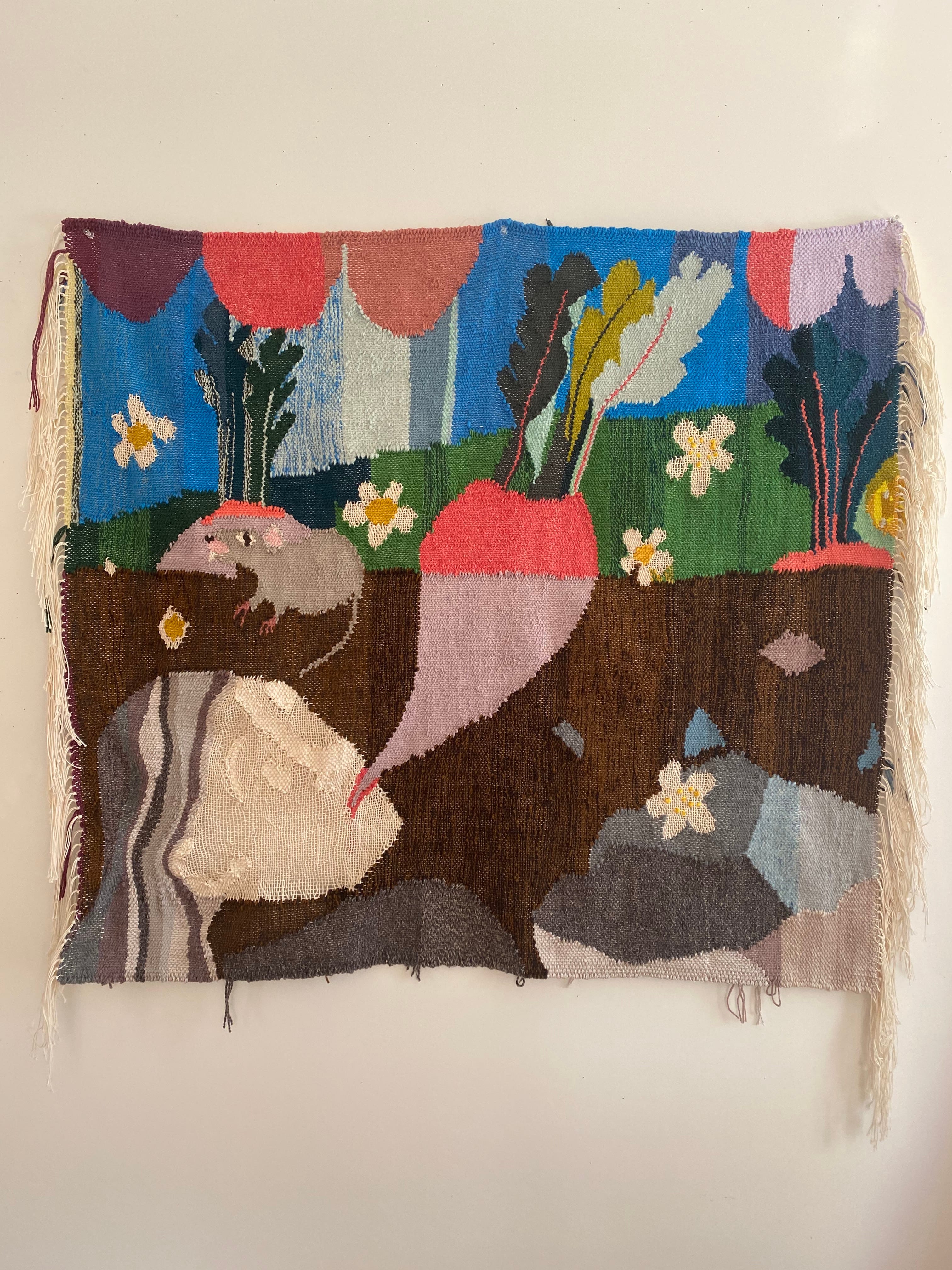
A few years ago, the artist Christina Forrer reached out to me to talk fairy tales, and I instantly fell head over heels. No one, in my opinion, weaves fairy tales like Forrer. Here is Forrer’s The Turnip Princess (Rübliprinzessin), 2022. Cotton and wool, 37 × 39 inches (94 × 99 cm)
In honor of her forthcoming book, I wrote this small essay:
The Rusty Nail
Twenty-six days before our house burns down, my son steps on a rusty nail. It goes through the sole of his sneaker. “The hole in his foot is small,” says the school nurse, “but you should come pick him up. He is limping.” I am supposed to be meeting with the artist Christina Forrer to talk about her fairytale weavings on the occasion of her exhibition at the Wadsworth Atheneum Museum of Art, but Noah steps on a rusty nail and I have to reschedule. This is twenty-six days before our house burns down if you count December 5th, the day it burns. “Noah’s tetanus is up to date,” says the nurse, but just in case I double check his records which are neatly labeled “Noah Medical” in the bottom left drawer of my roll top desk. At first I can’t find “tentanus,” but then I realize it is abbreviated to tdap, which includes the diptheria and acellur pertussis vaccination. “I found it,” I say out loud to no one. “He’s good,” I say, even though Noah is limping. Even though my son has a hole in his foot.
Everything will be okay because I know where everything is. I have proof of protection, and where there is proof of protection there is proof of existence.
“I am so sorry I had to reschedule,” I say to Christina days later over Zoom. “This was the rusty nail.” I hold the nail up to the screen to show her. This is the last conversation I will have in my office which will soon be a charred husk, and the nail I am holding up as proof of emergency will be one of thousands and thousands of objects soon lost in the fire. Christina tells me just before I told her about Noah and the nail she read Franz Xaver von Schönwerth’s “The Turnip Princess,” and isn’t that the strangest coincidence? It’s a fairy tale about a rusty nail and the magic it possesses. She had been planning to ask me about the fairy tale, and about the nail and the turnip. “Maybe the nail fell out of the fairy tale and made a hole in my son,” I say, half hoping it true.
“What I love most about “The Turnip Princess,” I say, “is that it’s a fairy tale that shows what’s beneath the skin of enchantment.” A bear tells a prince if he pulls a rusty old nail out of the wall of a cave he will be set free, and the prince will be rewarded with a beautiful wife if he then puts the nail under a turnip. But as I talk about “The Turnip Princess,” the fairy tale begins to fall apart in my head. I feel it unraveling. I need Christina to stitch the story back together. What happened again? Does the prince falls asleep? Why a turnip? And why does the turnip turn into a bowl that looks like a nutshell? And why inside the nutshell is there the imprint of a maiden’s foot? “I mean what I love most,” I say, “is when the prince only manages to get the rusty nail halfway out of the cave and the bear is half animal half human and the ‘disgusting old woman’ is half ugly half beautiful. It’s a fairy tale that shows what hides inside us.” What do I even mean by this? How long, I wonder, did the bad wire in my bathroom exhaust fan burn before it lit my whole house on fire? “Without you even knowing it could’ve been slowly burning,” says the fire inspector, “for days.”
In the weeks and months after the fire, I imagine myself in Christina’s studio surrounded by cotton and wool and watercolors. I imagine her weaving everything we lost into a tapestry. My stomach knots around the warp and weft of what once was. I miss the house we once called home.
The hole in Noah’s foot heals quickly. I check my inbox. Christina has sent me a photo of her new weaving. It’s “The Turnip Princess” made out of cotton and wool and it’s 37 x 39 inches, and in her weaving it’s not the nail that is half inside half outside, but a turnip pushing up through the soil and rooted in a buried woman’s mouth. The turnip is also a speech bubble, a wordless language of thread, the necessary silence in every good story. A small grey mouse waits above her. The turnip and the mouse are so unburnt. I don’t remember a mouse in “The Turnip Princess.” And so I reread the fairy tale. I search for the mouse. I call out to him but he doesn’t answer. He is missing from the fairy tale, but now Christina has woven him into the story at the crease between the seen and the unseen, between what’s above and below. The mouse, like the rusty nail once did, fills in the hole between two worlds. I want to touch the weaving, pet the mouse, but I am too far away, and so instead I zoom in on my computer screen so that the mouse’s face is very close to mine. “How do we know we aren’t dead?” I whisper into his small pink ear. The mouse says nothing for a long time. And then in a language of soil and rust and ash he answers me. It’s only one sentence, but I am still translating years later. The best translation I’ve been able to come up with is “as sure as I’m not dead, you aren’t dead too.” But it’s possible this translation is slightly off. It’s possible this translation is entirely wrong. It’s possible this mouse, like some of us, escaped into this fairy tale minutes before the one he originally belonged to caught fire and burnt down.
Ah, gorgeous,